|
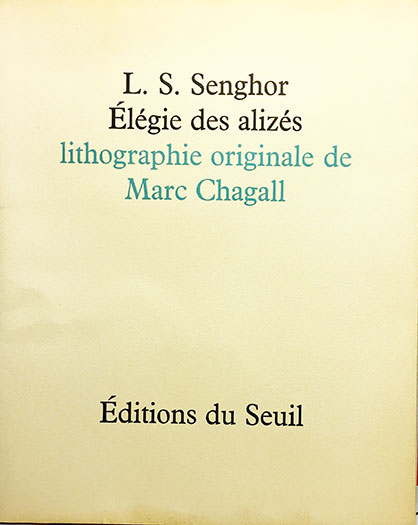
Léopold Sédar Senghor - Élégie des Alizés - Edition Originale. by MISC. ART BOOKS |
|||||||||||||||||||||||||||||
|
|
||||||||||||||||||||||||||||
| Notes |
| WITHOUT CHAGALLS LITHOGRAPH. SENGHOR, Léopold Sédar. Élégie des Alizés. (Elegy for the Trade Winds).Éditions du Seuil, Paris, 1969. Slim quarto, five loose gatherings in original cream paper wrappers. Edition Originale, number 44 of only 450 copies, of Senghors Élégie des Alizés (Elegy for the Trade Winds). Internationally recognized poet, politician, and cultural theorist, who served as the first president of Senegal, Léopold Sédar Senghor avoided the Marxist and anti-Western ideology that had become popular in post-colonial Africa, choosing instead to form a close relationship with France and the Western world. He was instrumental in the cultivation of postcolonial aesthetics and black African consciousness. His poetry reflects an all-embracing humanism which envisions the solidarity of all men, with each nation making its contribution in its own special way to a universal civilization (Albert S. Gerard). Critics continually point to his ability to synthesize elements of Western and African experience and to evoke universality in the imagery of his verse. Senghor is not merely a Frenchified African who tries to give exotic interest to his French poems; he is an African who uses the French language to express his African soul (Ulli Beier). Text in French. |